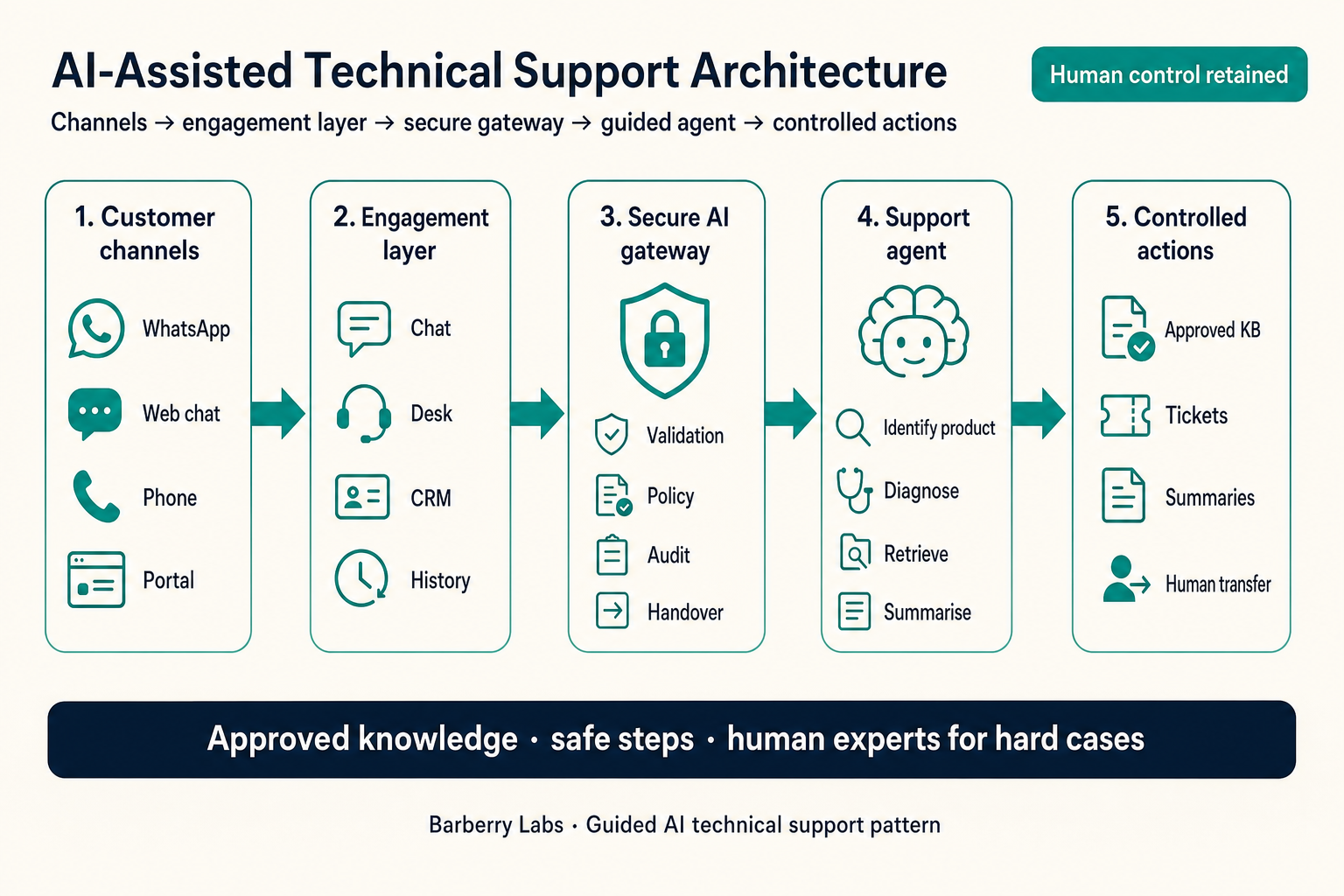
The short version: This is not primarily a chatbot opportunity. It is a guided technical-support agent that identifies product and version, establishes the symptom, retrieves only approved procedures, walks one safe step at a time, records the outcome and escalates with a complete diagnostic trail. Human experts retain control of difficult and safety-sensitive cases.
What changes for the business
How value is reported: support hours released, faster useful answers, better handovers and lower repeat-contact rate — not “replace the support team.”
The business problem a search bot does not solve
Many product OEMs already have the hardest raw ingredient: a large, structured technical knowledge base covering manuals, wiring diagrams, troubleshooting steps, configuration procedures, app issues and repair escalation. The material is deeply divided by product family, model, generation and procedure type.
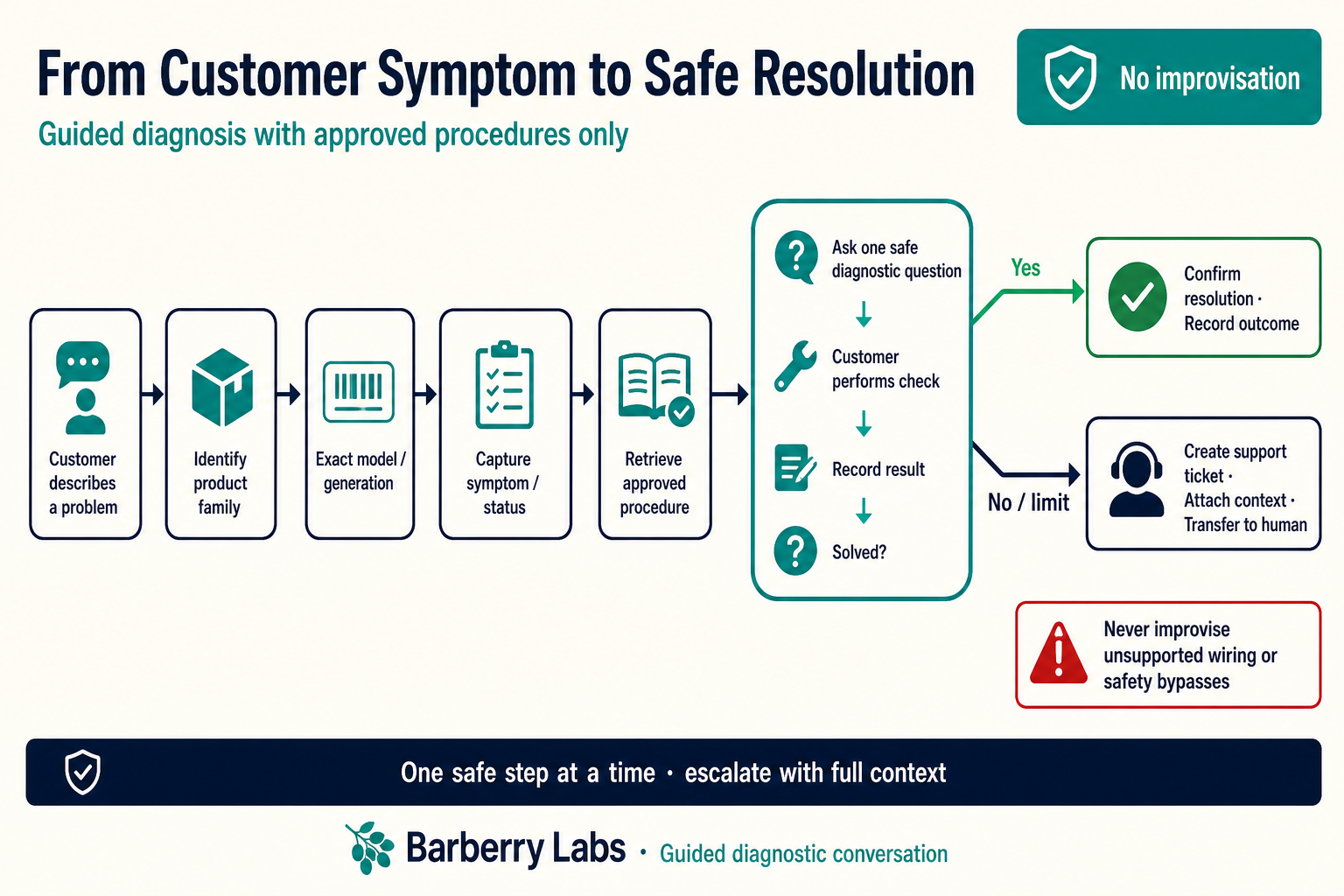
A customer can ask a perfectly reasonable question — “it opens but won’t close” — and still arrive at the wrong procedure because they selected the wrong model, generation or controller. A normal search bot returns several articles. A guided agent first establishes product, symptom, status indicators and what has already been tried.
| Generic chatbot | Guided support agent |
|---|---|
| Returns several articles and hopes the user picks correctly | Identifies product family, model, generation and controller first |
| Improvises when the corpus is ambiguous | Retrieves only approved sources and cites them |
| Dumps multi-step advice in one message | Guides one safe step at a time and records the result |
| Handover is a blank ticket | Human receives product, symptoms, sources and completed checks |
Recommended opportunity portfolio
Start with one bounded pilot, then expand. Priority is value against complexity and safety risk — not “deploy AI everywhere.”
1. Guided WhatsApp agent
First pilot: read-only guidance and ticket creation for one high-volume product family.
2. Human support copilot
Assemble customer, product, ticket and article context before the agent responds.
3. Knowledge intelligence
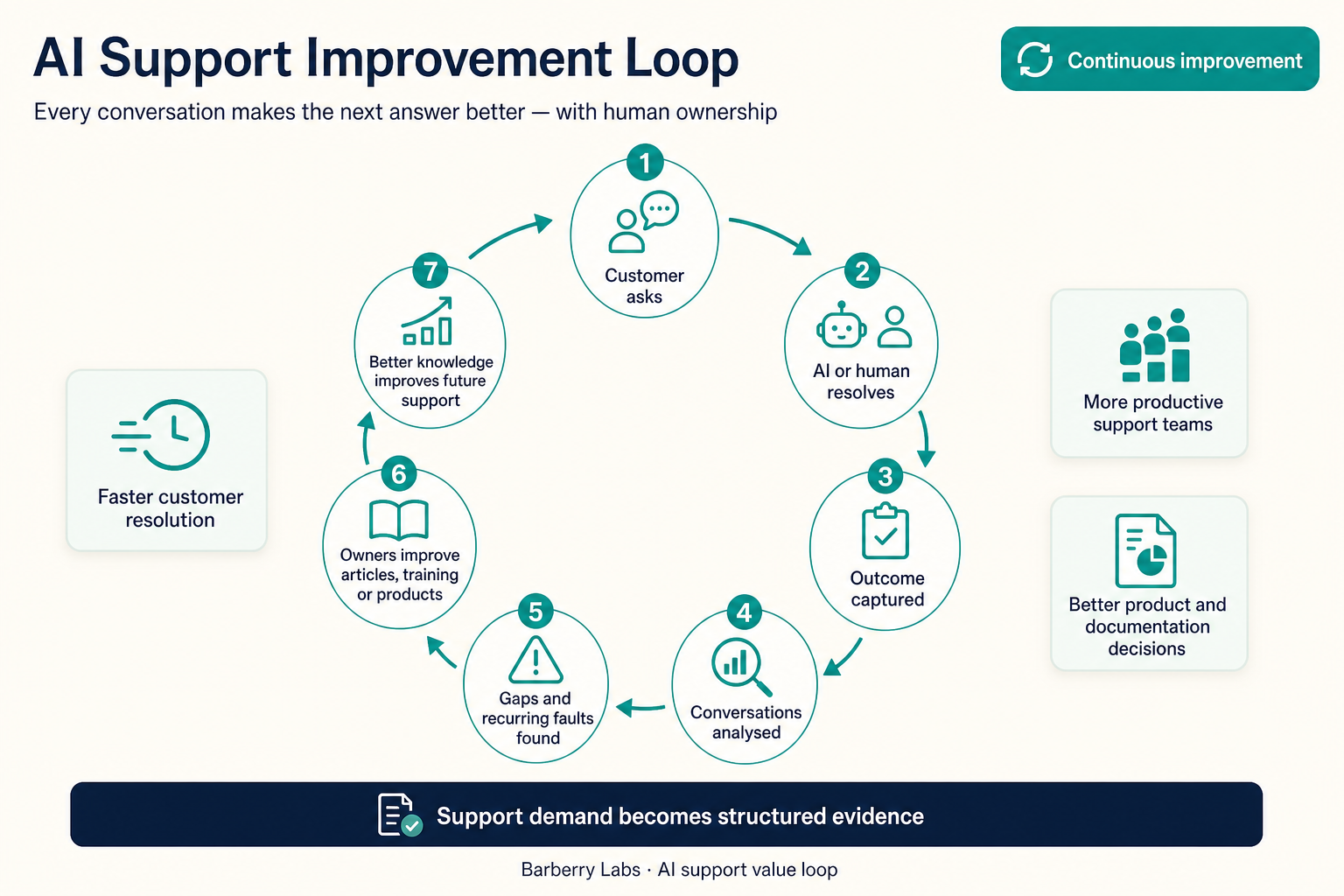
Find missing, duplicated, confusing or outdated technical content from real conversations.
4. Call intelligence
Turn recordings into searchable evidence and flag unresolved or high-risk customers early.
5. Support-to-product feedback
Convert support demand into structured evidence for training, quality and R&D.
Later: warranty / repair
Higher risk. Only after guided diagnosis, citations and escalation quality are proven.
How the guided conversation works
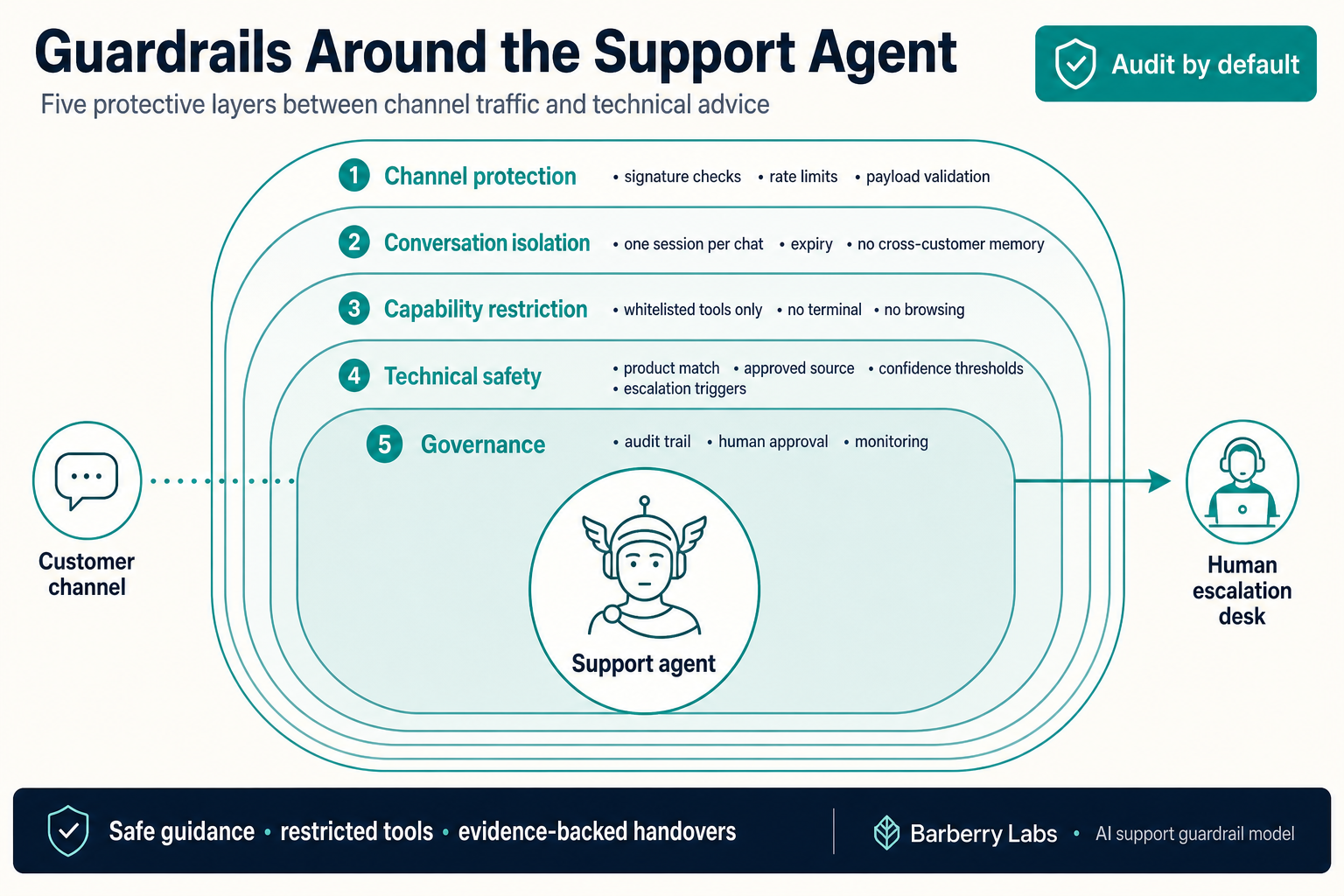
Klara interprets the customer’s language, asks clarifying questions, chooses approved retrieval tools, maintains diagnostic state and recommends escalation when confidence or safety limits are reached. Deterministic controls around the agent restrict retrieval, block unsupported wiring or safety-bypass guidance, require citations and log every source and tool call.
What the agent may and may not do
| May | May not |
|---|---|
| Explain approved user-level checks | Invent terminal connections or wiring |
| Ask for an image of a controller or display | Advise bypassing safety devices |
| Link the relevant article, diagram or video | Approve warranty replacements |
| Record successful and unsuccessful steps | Instruct work on live mains power |
| Create a desk ticket and forward to a human | Continue when the model cannot be identified |
Beyond the first pilot
Human support copilot
When a conversation reaches a person, the copilot assembles CRM history, desk tickets, the current thread and approved technical sources into one page: likely issue, checks already completed, relevant article, suggested next question and a draft response the human reviews before sending.
Knowledge-base optimisation
Support conversations reveal missing, duplicated, confusing or outdated articles. AI may recommend and draft improvements. A technical owner must approve electrical instructions, safety procedures, firmware applicability and warranty guidance before anything publishes.
Recommended pilot shape
| Dimension | Pilot boundary |
|---|---|
| Product scope | One clearly delimited high-volume product family with an available technical owner |
| Knowledge scope | Approved FAQs, user-level troubleshooting, model ID material, manuals and escalation paths |
| Initially exclude | Live mains work, advanced installer wiring, safety bypasses, board-level repair, warranty decisions |
| Channels | Internal test → shadow mode beside humans → limited live intents → guided diagnosis |
| Success measures | Correct product ID, correct article retrieval, safe escalation, deflection, handling time, unsafe-answer rate near zero |
Commercial framing: test whether approved technical knowledge can safely resolve repetitive questions, shorten remaining human conversations and improve handover quality — not whether a percentage of the support team can be removed.
What executives should take from this
- A large knowledge base is necessary but not sufficient — navigation and model identification are the real bottlenecks.
- Guided diagnosis beats article search when procedures depend on product generation and status indicators.
- Safety-sensitive domains need approved sources, product match and mandatory escalation — not a general model improvising.
- Start with one product family, offline evaluation and shadow mode before customer-facing automation.
- Measure hours released, answer quality and handover completeness — not chatbot vanity metrics.
Related
- AI automation consulting
- How to scope an AI agent project without wasting budget
- Connected-system migration use case
Talk to us
If your support team already owns a deep technical knowledge base and still spends peak hours on repetitive first-line diagnosis, book an architecture session with Barberry Labs. We will help you choose a bounded product family, define guardrails and test the pattern against historical conversations before anything faces customers.