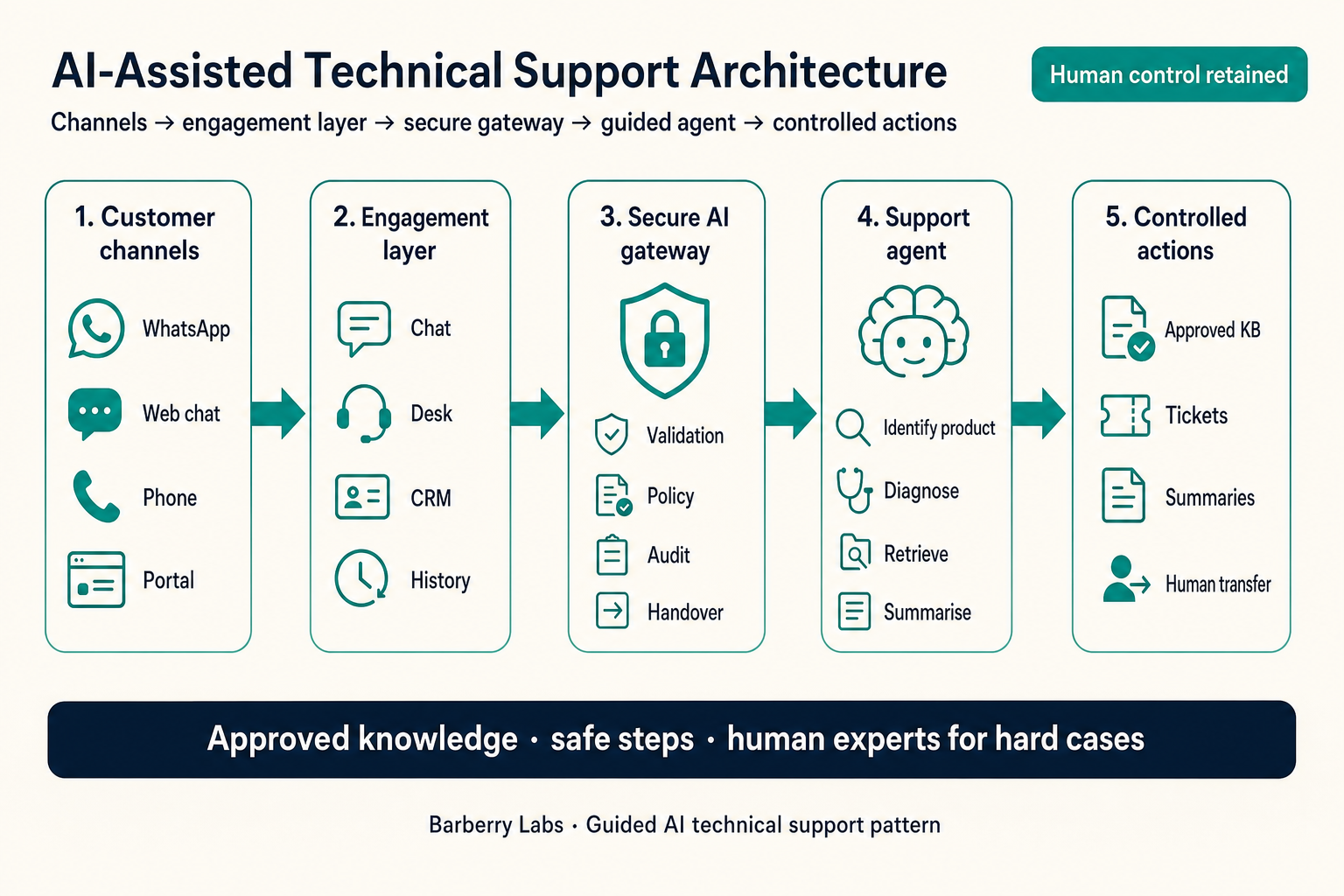
The short version: A real support bot handled sensor and device questions by asking for the right context, querying the approved databases and manuals, and guiding safe next steps. It could often narrow an investigation from half an hour to two hours down to about five minutes. It did not make material changes: those were deferred to a human through the existing CRM and ticketing workflow.
The executive case: faster diagnosis, not an uncontrolled bot
These are outcomes from the documented IoT support workflow. They are not a promise for every product or support environment; volumes, data quality, procedures and validation rules matter.
Start with the questions technicians answer repeatedly
The useful starting point is not “deploy an AI assistant everywhere.” It is the small set of repeated, trained questions that consume first-line technical support time:
- Why is my device offline?
- Why does this reading look wrong?
- Why is my water meter not running?
- Why does the dashboard graph look like this?
- Why can this device not be added to the app?
Each can have several possible causes. A useful assistant does not jump to a generic answer. It asks context-setting questions from the original customer engagement, identifies the device type and quality/state, then uses the permitted data and approved manuals to guide the next safe check.
What changes when the assistant can see the right context
| Traditional investigation | Controlled IoT support assistant |
|---|---|
| Technician searches manuals and several systems before narrowing the issue | Asks targeted context questions, identifies the device and queries the permitted database records |
| An offline device creates a broad investigation | Can show when it was last online and guide approved checks that may restore connectivity |
| A strange graph or reading is described from memory | Uses live device and historical context to focus the diagnosis |
| A routing-group problem can take prolonged manual analysis to discover | Scripts can analyse the relevant data and quickly reveal that information is being routed to the wrong place |
| Knowledge improves only when somebody later writes it down | Repeated questions and resolved paths become evidence for a stronger training and knowledge base |
The difference is not that the system “knows everything.” It is that the assistant can combine the right approved procedure with the right operational context without asking a technician to reconstruct the same investigation from scratch.
The boundary that keeps support safe
Good technical support should be decisive about information and cautious about change. The bot could read relevant information, explain what it found and recommend a documented next step. Significant changes stay with a human.
Escalation was also available whenever the customer explicitly wanted to speak to a person. That makes the automation accountable: the support team receives the device context, symptom, checks completed and likely issue instead of a blank new ticket.
Why the first pilot should be deliberately simple
The commercial starting point is a first-line support pilot for the repeated, low-risk questions. It keeps the support journey trackable in the customer’s existing CRM and ticketing system, avoids unbounded access, and lets the team validate answers against real cases.
Once the workflow proves itself, it also improves the underlying support operation: the questions, missing procedures and successful troubleshooting paths can be turned into higher-quality technician training and customer self-service material.